Phase identification is one of the final procedural steps before a medium-voltage cable is reconnected or returned to service. Although it is sometimes treated as a routine verification, its technical importance is considerable. Incorrect phase alignment can lead to reversed rotational fields in three-phase systems, unexpected mechanical behaviour in connected equipment, and, in looped networks, severe electrical faults when circuits are closed.
Ensuring correct phasing is therefore not simply a matter of labelling. It is a safeguard for both personnel and system integrity.
In many traditional workflows, however, the method for confirming phase alignment involves temporarily removing the earth connection at one end of the cable. This procedural requirement alters the electrical condition of the conductor during the identification process and introduces avoidable exposure.
When earthing and short-circuiting are applied in accordance with established safety rules, the cable is placed in a defined electrical state. Any unexpected voltage appearing on the conductor is immediately discharged to ground, and the potential of the cable remains controlled and predictable.
In a common continuity-based phase identification in the trench. To determine the phase, the earth is lifted at the far end of the cable. A technician in the trench connects a continuity tester between the conductor and sheath, while a second person at the far end opens the earth connection and short-circuits each phase in turn. The resulting change in resistance is interpreted as confirmation of the phase.
The logic of the method is straightforward. The concern lies in the temporary removal of the earth connection. Once lifted, the conductor becomes electrically floating and no longer has a defined reference potential.
In this state, several well-understood electrical phenomena become relevant.
Medium-voltage cables are frequently installed in parallel with other heavily loaded feeders. A conductor carrying a significant current produces a magnetic field that extends into the surrounding space. If a nearby cable is isolated but unearthed, that magnetic field can induce voltage within it through electromagnetic coupling.
The magnitude of induced voltage depends on factors such as current level, proximity, shared route length, and cable geometry. In long parallel runs, the effect can be significant.
When the cable remains earthed, induced energy is safely dissipated. When the conductor is floating, voltage can accumulate until a discharge path is provided.
Distribution networks increasingly incorporate distributed generation, including photovoltaic systems and embedded generators. In addition, medium-voltage systems often include looped configurations and T-joints, creating multiple potential supply paths.
Under these conditions, a conductor may become energised from an unexpected direction if switching states are misunderstood or incomplete. With the earth connection in place, such energisation results in an immediate fault that is detected by protection systems. Without it, voltage may be present on a conductor that is assumed to be safe.
Power cables possess inherent capacitance. Capacitance increases with conductor size, insulation characteristics, and cable length. Following insulation testing or previous energisation, electrical charge may remain distributed within the dielectric material.
Even after discharge and earthing, internal stresses within the insulation can cause voltage to reappear gradually once the earth is removed. In long, high-capacitance cables, this recovery voltage can reach hazardous levels.
Maintaining the earth connection prevents such a charge from building to a dangerous level. Removing it allows the conductor to drift electrically until a new reference is established.
The traditional continuity-based phase identification method functions as intended from a measurement perspective. Its limitation is procedural rather than conceptual.
To perform the identification, the cable must be temporarily unearthed. During this period, the conductor is not in its defined safety condition. In modern networks characterised by high load density, distributed generation, and complex topology, this temporary change in state introduces risk that is increasingly difficult to justify.
A more controlled approach maintains earthing throughout the identification process.
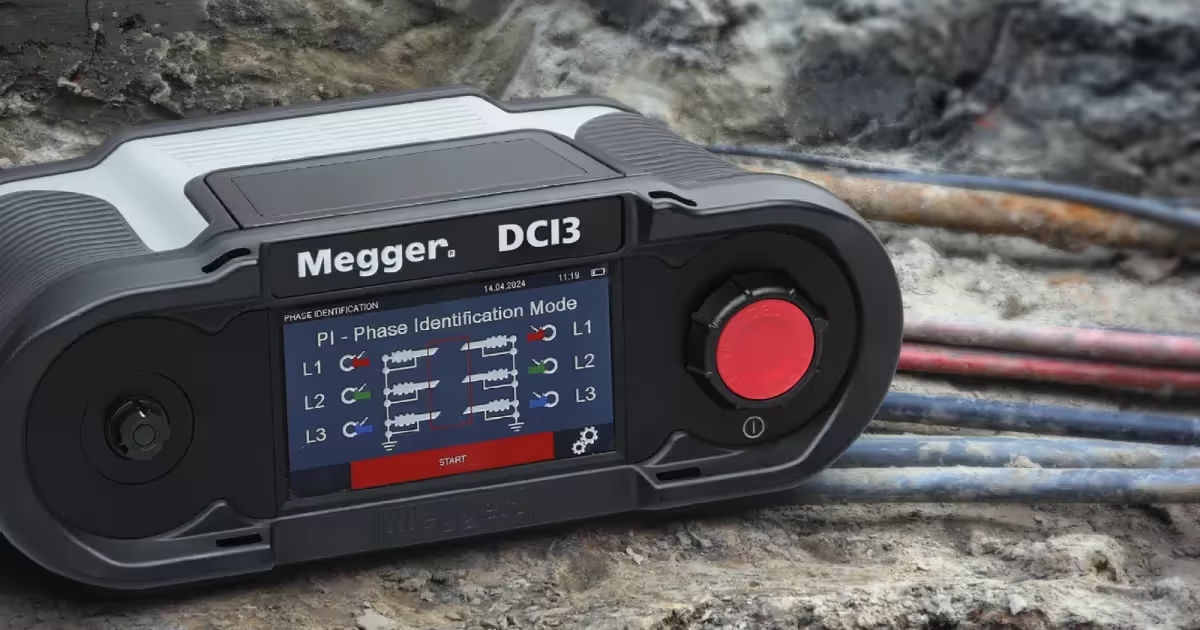
Modern phase identification systems such as DCI3 are designed to confirm conductor alignment without removing the earth connection.
After applying the five safety rules and establishing earthing and short-circuiting, phase identification clamps are installed at the far end of the cable. These clamps are passive and do not rely on batteries. Flexible variants are available for larger conductors or installations where space is limited.
In the trench, the DCI3 is connected between the conductor core and the sheath of the cut cable. When the test is initiated, the instrument injects a defined frequency into the conductor. This produces a magnetic field that is detected by the clamp. The clamp stores energy and transmits a coded frequency response once the instrument ceases transmission. The DCI3 decodes this response and automatically identifies the phase.
Throughout this process, the cable remains earthed and short-circuited. The electrical condition of the conductor does not change during measurement. Induced energy is dissipated, backfeed sources remain suppressed, and stored charge cannot develop hazardous potential.
The identification result is obtained without altering the defined safety state.
Correct phase alignment protects more than the technician performing the work. Incorrect phasing can result in reversed rotational fields, mechanical stress on connected equipment, and severe electrical faults when circuits are closed. In critical infrastructure environments, these consequences can extend well beyond the immediate installation.
Maintaining earthing during identification ensures that the verification process itself does not introduce additional exposure before reconnection.
As distribution networks continue to evolve in complexity, procedural control becomes increasingly important. Phase identification should be carried out in a manner that preserves the defined safety condition of the cable from isolation through to reconnection.
Maintaining earthing throughout identification provides a stable electrical reference, reduces exposure to induced and backfed voltage, and ensures that the conductor remains in a predictable state until it is safely returned to service.
For modern medium-voltage applications, this level of control represents a considered and technically robust approach to cable work. The DCI3 can also identify phases in low-voltage applications.