Cable identification should be simple. But anyone who works on power networks knows it rarely is. You might be stood in a joint bay that’s barely wide enough to move in, dealing with rain blowing sideways into the work area, dust kicking up from passing traffic, or the tight geometry of a cabinet that clearly wasn’t designed with your tools in mind. Even a basic task like confirming the right cable can turn into a juggling act: one device for cable identification (CI), another for phase identification (PI), another for live LV work… all while knowing that one wrong cut can stop a network in its tracks.
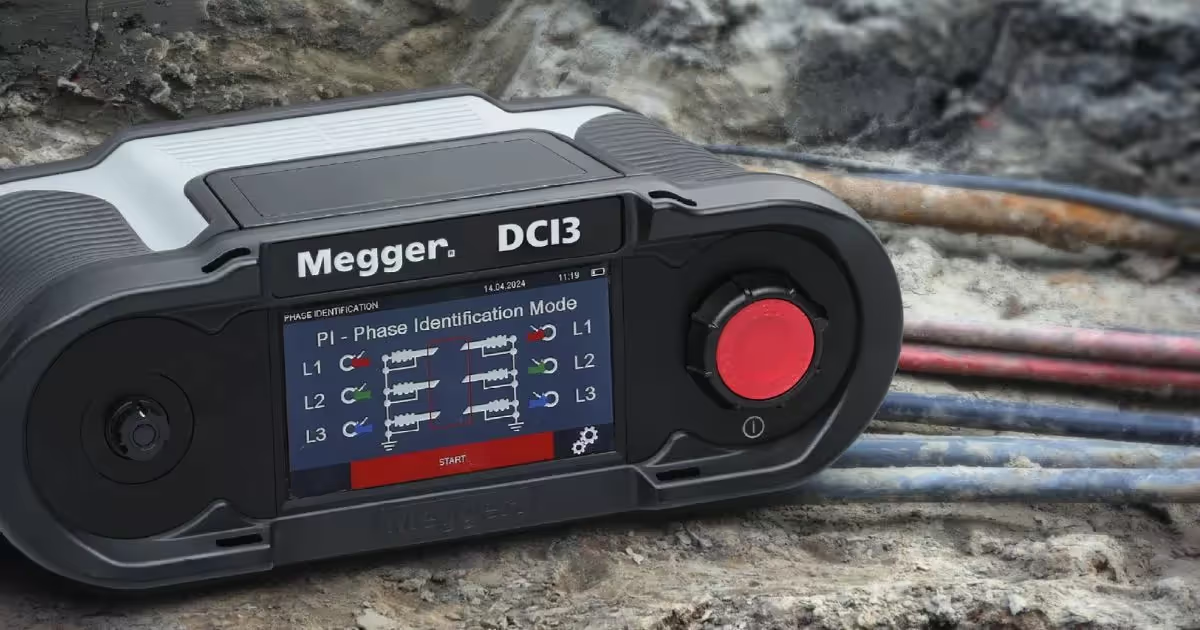
DCI3 was designed for exactly these environments — not as a lab instrument, but as a tool built around the way crews actually work.
Ask any cable jointer or commissioning engineer and the frustrations come quickly. CI itself isn’t usually the problem — it’s everything around it. Weather is unpredictable. Space is often too tight. Not every cable sits where you’d like it to. And switching between multiple kits adds more steps to a task that already demands absolute certainty.
Older PI systems often relied on clamps with internal batteries, which weren’t always charged when you needed them. Rigid clamps didn’t always fit the cable size. And on long cable runs — such as in renewables or utility networks — repeating tests could easily consume the little time a maintenance window gives you.
What technicians want is straightforward: equipment that works every time, fits where it needs to fit, and keeps them moving.
DCI3 brings CI and PI together into a single, weather-resistant system. Instead of carrying separate kits or changing devices mid-task, the entire process — from confirming the correct cable to verifying the correct phase — can be handled from one platform. For crews, this means fewer reconnections, fewer trips in and out of pits, and less time managing equipment.
One of the biggest advantages is how well the system performs on long runs. DCI3 provides confident identification on cable lengths up to 30 km, maintaining a strong directional signal even on noisy networks or in situations where AF-based tools may struggle with interference.
Its clamp options adapt to the environment. Passive clamps — which require no internal power — offer stable performance on long MV runs. Flexible clamps wrap cleanly around large cross-section cables and slide into cramped cabinets with minimal effort, making them ideal when space is working against you.
And when you need to identify live low-voltage (LV) cables, pairing the system with the live cable identification (LCI) transmitter makes the change effortless, with no need to swap kits or interrupt the workflow.
Picture a shallow joint bay on a wet morning. Space is tight, the cable you need is thicker than expected, and there’s no easy angle for a rigid clamp. With older equipment, that might mean heading back to the van or improvising. With DCI3, the flexible clamp slips neatly around the larger core, the RX3 receiver (RX3) shows clear pulse direction, and you have a confident result within seconds — without starting the setup again or pulling out another device.
This is the kind of situation where the system earns its keep.
DCI3 is designed for the people who keep electrical networks operating safely and reliably: cable jointers, field technicians, commissioning engineers, operations and maintenance (O&M) teams, and electrical crews working across renewables, rail, airports, and industrial environments. If identifying the right cable or phase is part of your job, DCI3 fits directly into your workflow.
Cable networks are expanding and becoming more complex. Undergrounding is increasing. Renewable installations cover huge areas with long cable runs. Maintenance windows are tighter, safety expectations are higher, and downtime is more expensive than ever. Crews are also more mixed in experience, meaning equipment needs to be intuitive, consistent, and safe for everyone who handles it.
In this context, tools that reduce friction and remove unnecessary steps become essential. DCI3 is designed to make the process simpler, quicker, and more reliable.
DCI3 helps crews identify faster, work safer, and stay productive — whatever the conditions on site.
Explore the DCI3 product page to see the full system, clamp options, and available configurations.