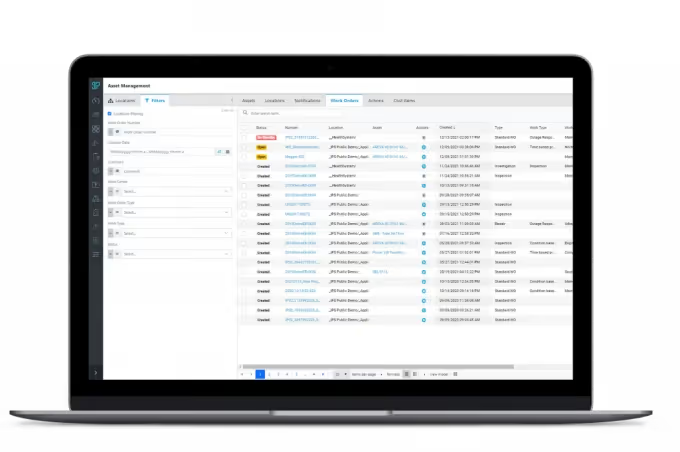

OMS provides utilities with live insights into outages, helping teams coordinate restorations, communicate effectively, and minimise customer impact.
An outage management system (OMS) is a specialized software solution used by operators of electric distribution systems to efficiently detect, manage, and restore power outages. By integrating with supervisory control and data acquisition (SCADA) systems, geographic information systems (GIS), customer information systems (CIS), among other systems, an OMS provides real-time situational awareness and decision support. Key functionalities include outage detection, fault location identification, restoration prioritization, and workforce management. OMS solutions leverage data analytics and the Common Information Model (CIM) to enhance network visibility, optimize response times, and improve grid reliability. These systems also support switching order management, real-time notifications, and outage analysis, reducing downtime and improving customer service continuity.
Full Service OMS
Our (Common Information Model) CIM-Based Outage Management System is a solution designed specifically for transmission organizations. By utilizing an AUTOMAP CIM Network Connectivity Model integrated with comprehensive Asset Management Data, we provide a seamless experience for managing network topologies and real-time situational awareness. OMS combines modules for Planned and Unplanned Outage Management and Switching Order Management. It offers native integration with other systems such as SCADA, DMS, PSS®E, various mobile solutions, lightning and weather data, Lidar, and many others.
Switching Order Management presents an important part of OMS and it is developed for managing the processes of providing conditions for safe operation on elements that are subject to disconnection requests.
It is fully compatible with Planned Outage Management and Unplanned Outage Management Modules, and all functionalities fully apply to planned and unplanned outages.
Switching Order Management enables the automatic creation of outage and clearance zones, the definition of borders, and the setting of appropriate tags. Users can use Switching Order Management to add, edit, and delete switching orders and all related entities, such as clearance orders, hotline hold orders, and switch hold orders. It also provides a mechanism for authorization and tracking all activities during the process.
The outage lifecycle begins with notifications, typically as unstructured textual data. Alternatively, notifications can be automatically generated by interfacing with IPS® Network Model Management (IPS®NMM), which reads various event logs and historians to create notifications within IPS®OMS.
Based on these notifications, an outage request is then created. OMS features advanced built-in functionality for Bundling Outages, which aims to reduce risks and lower costs by automatically suggesting the creation of a single outage instead of multiple smaller ones on interconnected elements.
The outage planner can identify the primary outage object, such as a line, power transformer, busbar, or compensator, and associate it with the outage request. Once the relevant equipment is identified, the planner determines the appropriate course of action.
Outage Monitoring
CIM Network Model or Asset Management based Geo Map presentation of the Outages with lightning information and real-time thunderstrike simulation, stations, and overhead line search.
Real-Time Outage Analysis
It can record the history of outages through the operations and provide real-time insights into the systems.
Instant Alerts
IPS®OMS features a notification center with outage identification and instant alerts via configured communication channels (e-mail, SMS, wake-up calls, ...).
Reduce Risk and Lower Costs
Users can leverage smart autosuggestions and insights to bundle outage requests and consequently reduce risk and save resources.