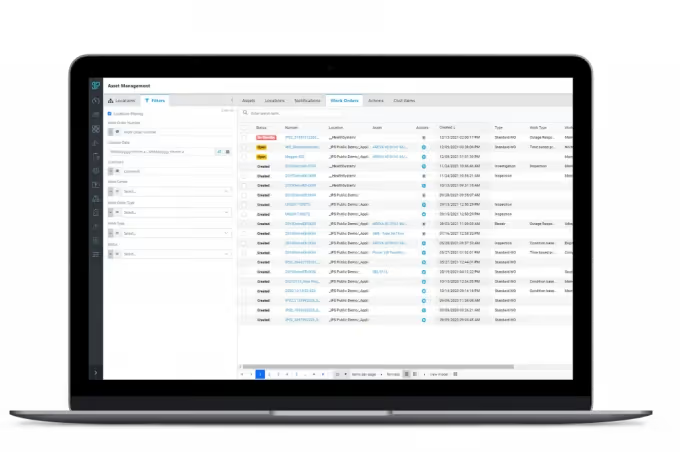

This solution consolidates configuration, testing, and compliance of relays and intelligent electronic devices. It ensures protection schemes are reliable, reduces operational risk, and streamlines regulatory compliance.
Our Protective Relays and IED Management solution offers an extensive library of complex data models and a master-type library for IEDs. Our solution’s advanced integration with Network Model Management across all protection areas sets it apart. It aligns with international standards IEC 61850 and IEC 61970, ensuring seamless interoperability and compliance. Additionally, our solution complies with NERC regulations (including PRC-023, PRC-025, PRC-026, PRC-027, and others), providing robust support for the highest power system protection and reliability levels.
Component Management
Our platform enables detailed modeling of digital assets through a component-based structure, allowing for the classification and organization of individual parts. Each asset can include multiple components arranged hierarchically for easier management. We’ve developed a standardized type-level design, similar to the IPS® asset type concept, to streamline tracking, analysis, and version control. Predefined component hierarchies can be auto-assigned during asset creation or later. IPS® Component Management offers advanced tools for managing digital devices and software components, ensuring compliance with regulatory, cybersecurity, and asset management standards. The system's rich data structure supports efficient tracking, filtering, and browsing, providing quick insights into vulnerabilities and maintenance needs for full IPS®SYSTEMS support.
Setting Workflow Management
IPS® Setting Workflow Management (IPS®SWM) is part of the solution, and it allows users to control all activities related to relay settings by utilizing a three-tiered structure. System Change Notification (i.e., description of any event or situation that may result in the modification of one or more relay settings), Global Setting Requests (affecting several physical relays), and Relay Setting Requests (involving one single physical relay). Each level has its workflow – the Global Setting Request (GSR) workflow is fully customizable.
Enterprise Wide Area Protection Coordination Process
Protective relay settings information is exchanged with third-party settings calculation tools and a network model. This exchange is the base and precondition for any Wide Area Protection Coordination (WAPC) study, resulting in settings change requests from the WAPC. The study can be sent back to the IPS® maintenance management process and distributed to protection maintenance teams for their commissioning.